
First Published 18 Dec 2025 Difficulty level: Moderate
Microsoft makes various Access template files available for download. Many of these databases are mainly intended for people starting to use Access and are designed to show how different features work. To view a short list of template files, go to the File Backstage view:

Click on More Templates to view all the available Office template files:
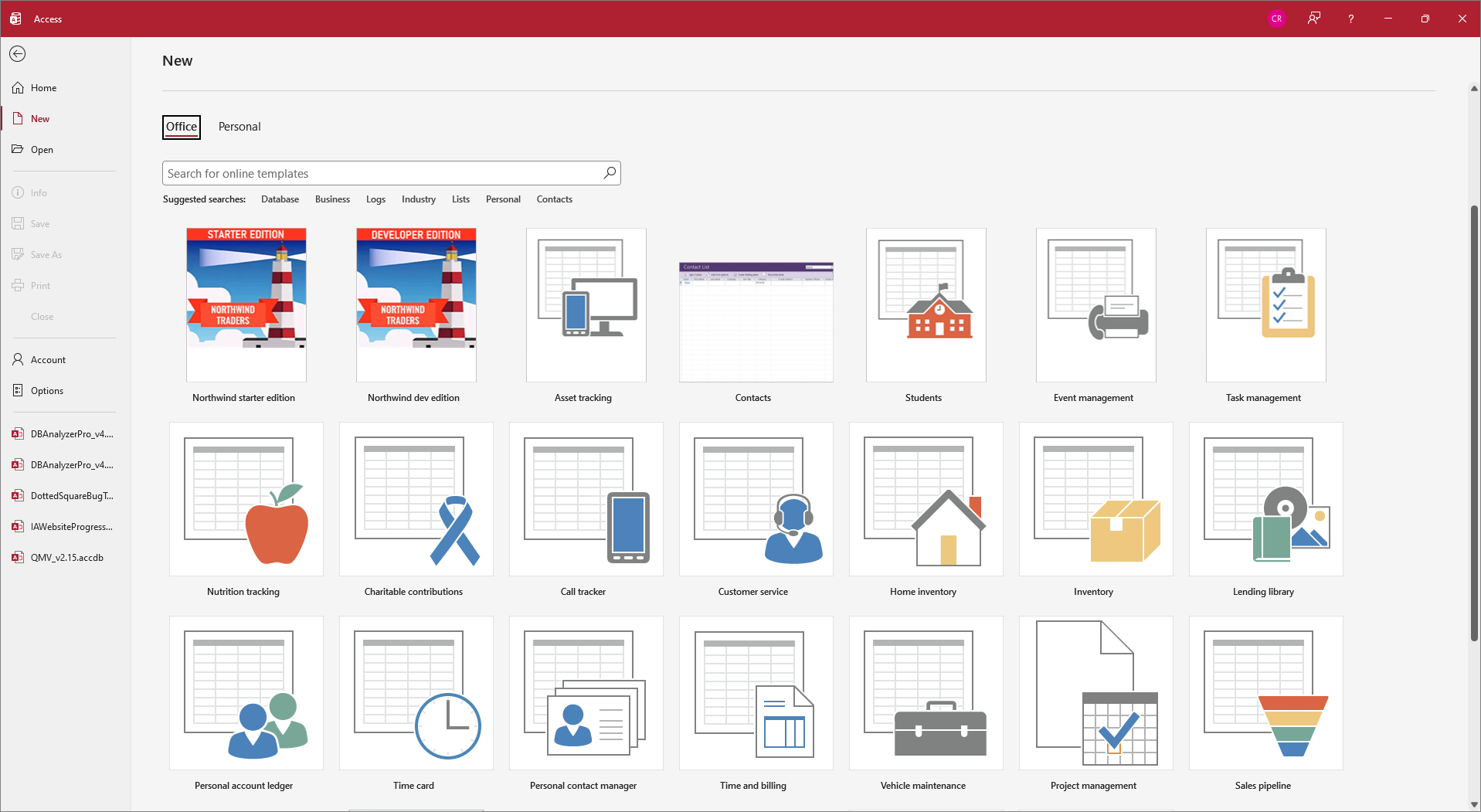
Although useful for new developers, it is perhaps worth pointing out that not all these templates are examples of good database practice.
Notable exceptions include the two new Northwind example databases (Starter / Dev editions), both of which are highly regarded by most Access developers.
These two template files were created by a group of experienced developers including current and former MVPs led by Tom van Stiphout and are widely used for reference.
When a template file is selected, a dialog opens with more information about the file. For example:
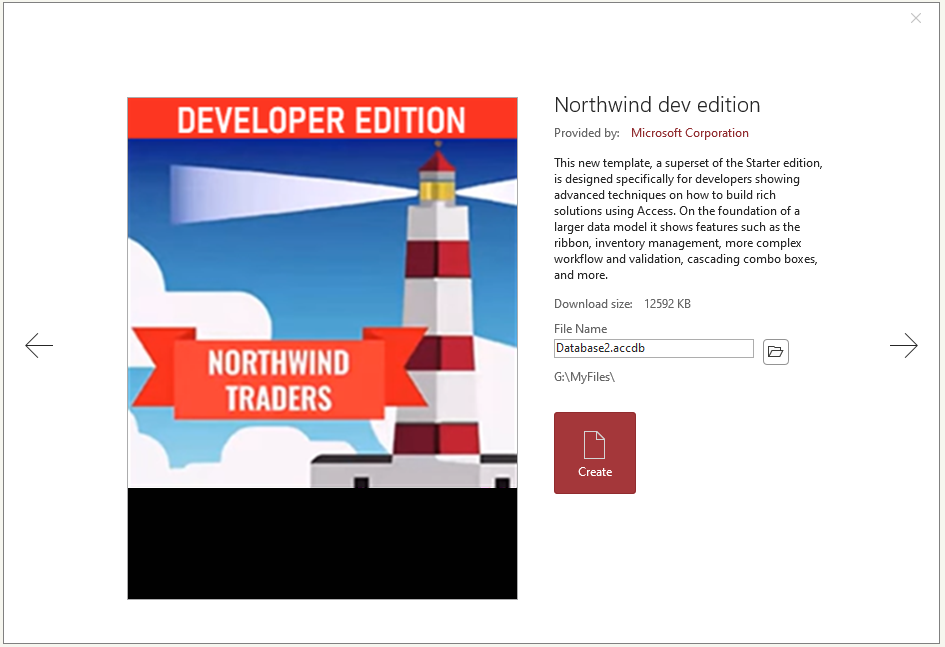
On clicking the Create button, the file is downloaded and the various parts assembled to create an .ACCDB file ready for use.
It is also possible to create your own personal template files. For example:
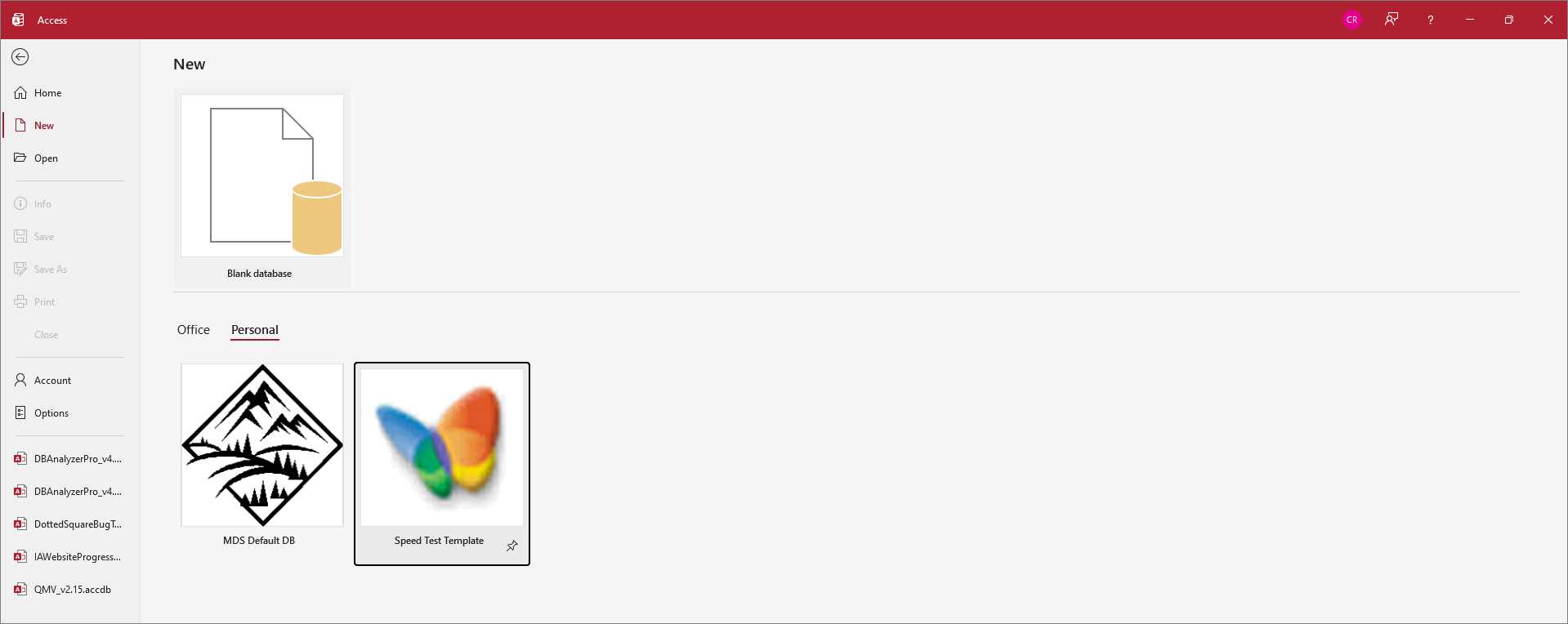
The process used to create templates is described in my earlier article: Application Parts and Templates
Although this feature is perhaps not widely used, it can be very useful where you need to create similar databases on a regular or repeating basis.
For example, I use this template file to create many databases for Mendip Data Systems:
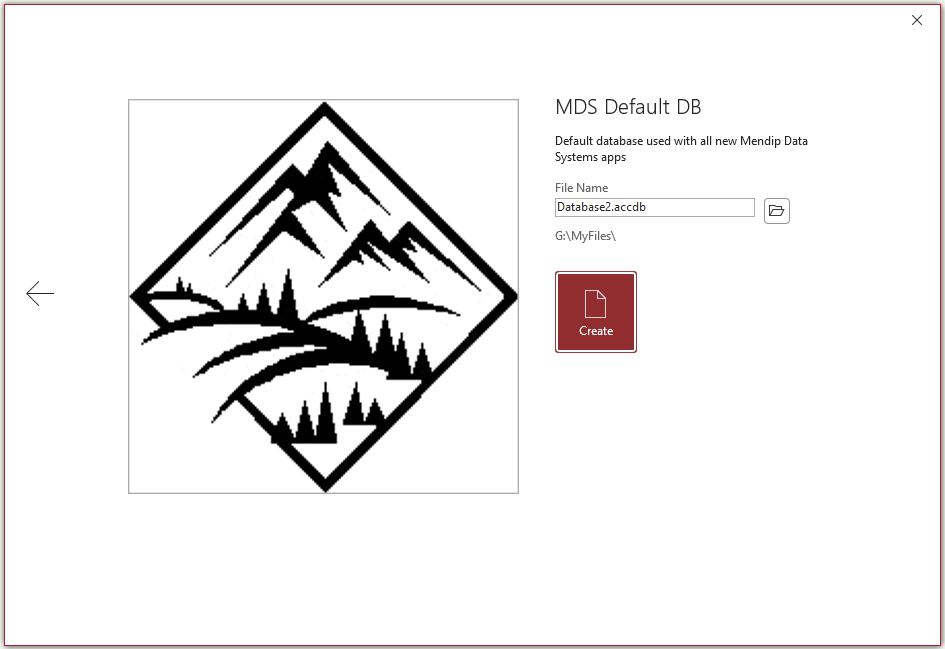
I also use another template file when creating application parts for a new Speed Comparison Test example app:
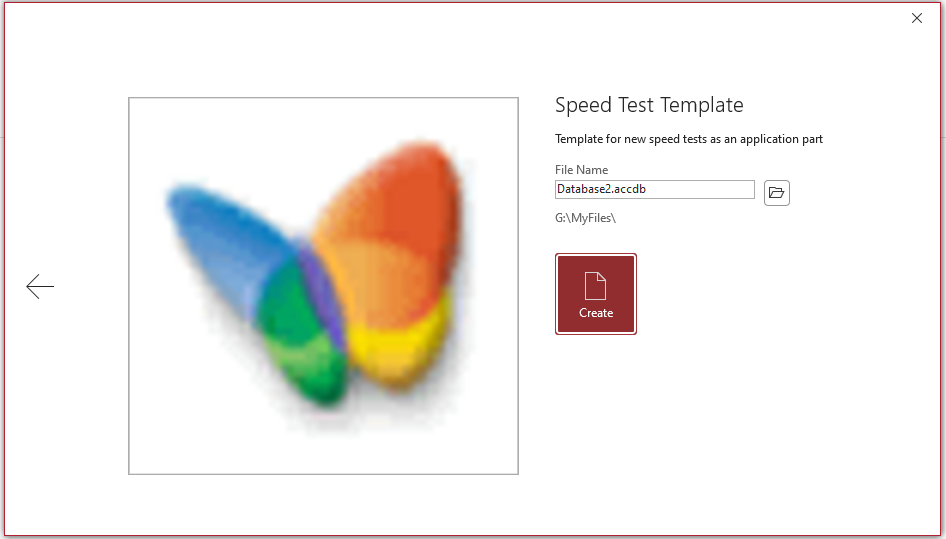
As my previous article states, application parts and database templates are variations on the same idea.
Both are intended to make it easy to reuse database design elements or an entire database from template files.
ACCDT Template File Structure
Each downloaded template file is shown in File Explorer as a single .accdt file. However, in reality each consists of several parts 'zipped' together.
To see how this works, make a copy of a .accdt file and rename it with a .zip suffix. Now double click the file to open it and view the file components. For example:

All .accdt files have almost identical components:
a strangely named [Content_Types].xml file contains basic info about the structure of the template file. This can be viewed in a text editor such as Notepad or a browser window:

Notice the Date Modified for this file! #30/12/1899 00:00# This is Day zero in Access!
• a zipped folder _rels with a single XML document file .rels containing info to create the relationships window

• a zipped folder docProps with a single XML document file core.xml. This contains the information displayed when you click on the template file in Backstage view:
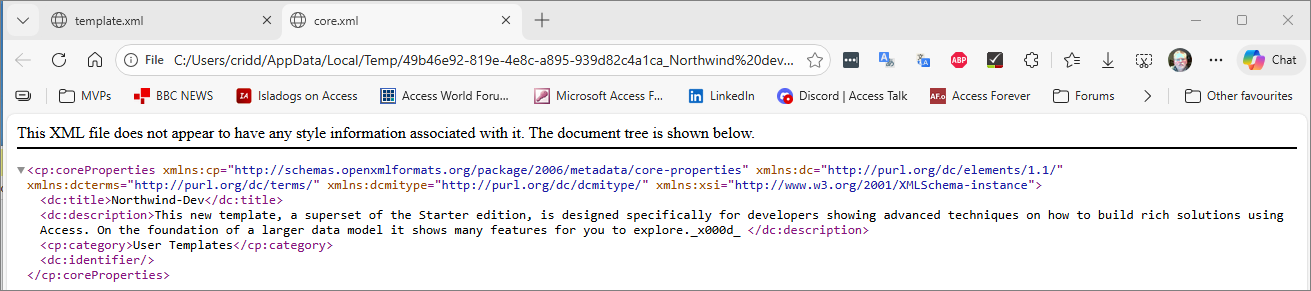
• a zipped folder template containing further subfolders and files

• the template.xml file with the main instructions for the file.
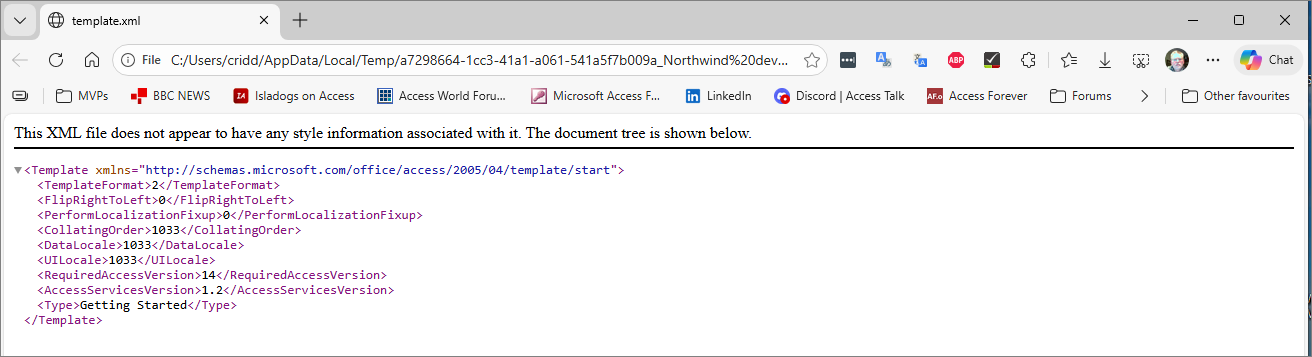
• The _rels sub-folder contains a much larger XML file with information about the links between the different database objects. Here is a small part of this file:
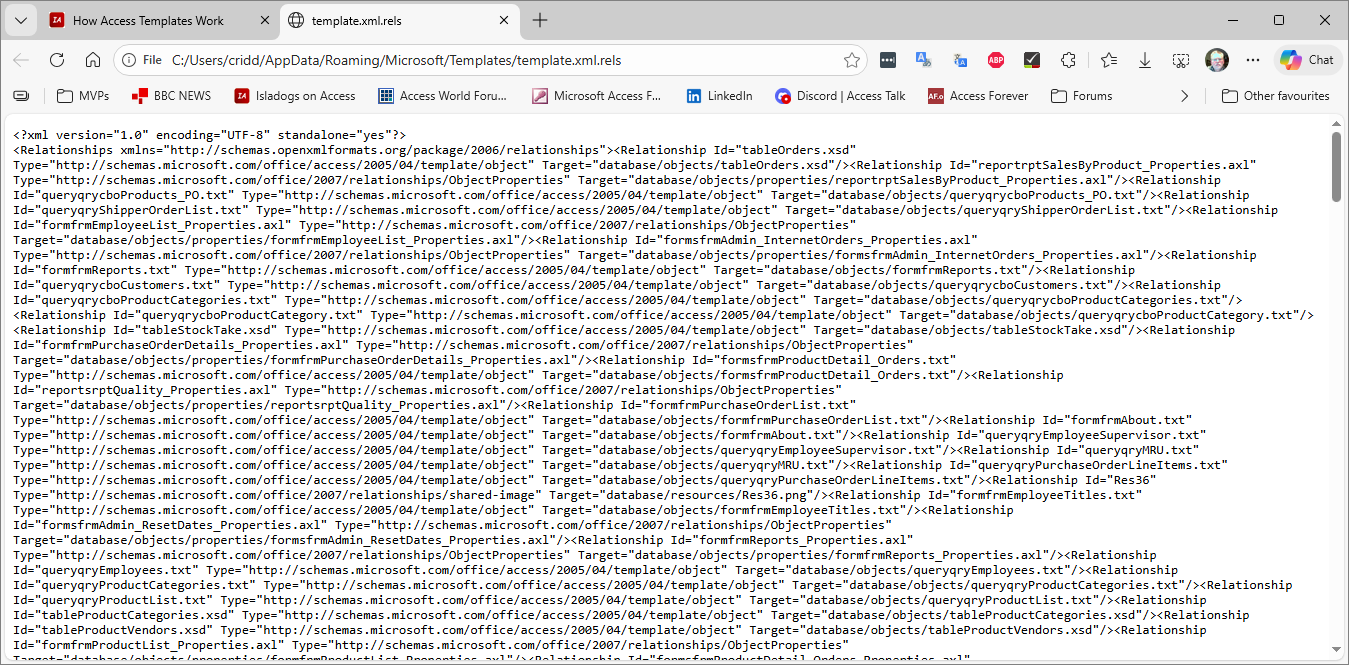
• The database sub-folder contains xml files containing information about database properties, navigation pane groups, object relationships (as stored in the MSysRelationships system table)
and the VBA References used by the database.
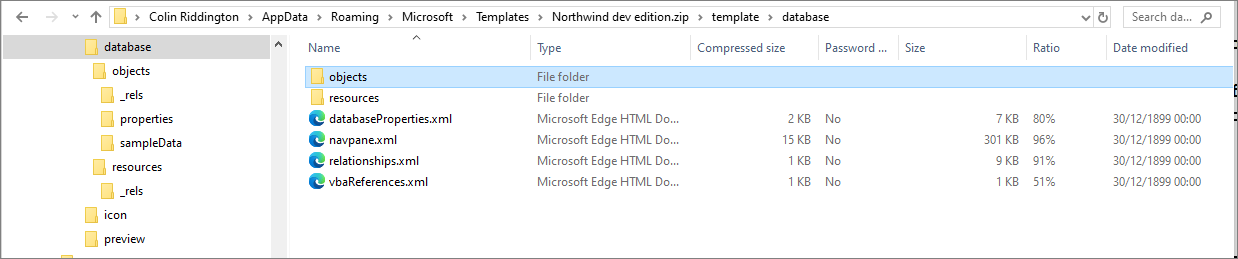
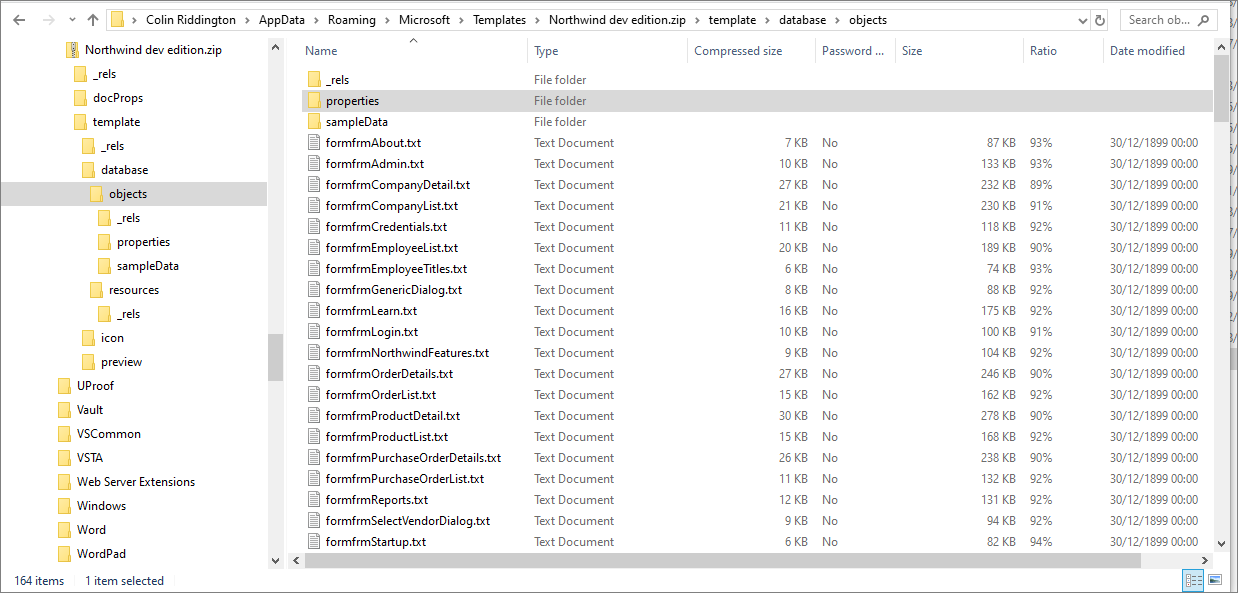
It also contains an objects subfolder which contains text files for reconstructing each database object together with further sub-subfolders holding sample data, metadata and properties
info for each object. All of these are in separate XML or AXL files
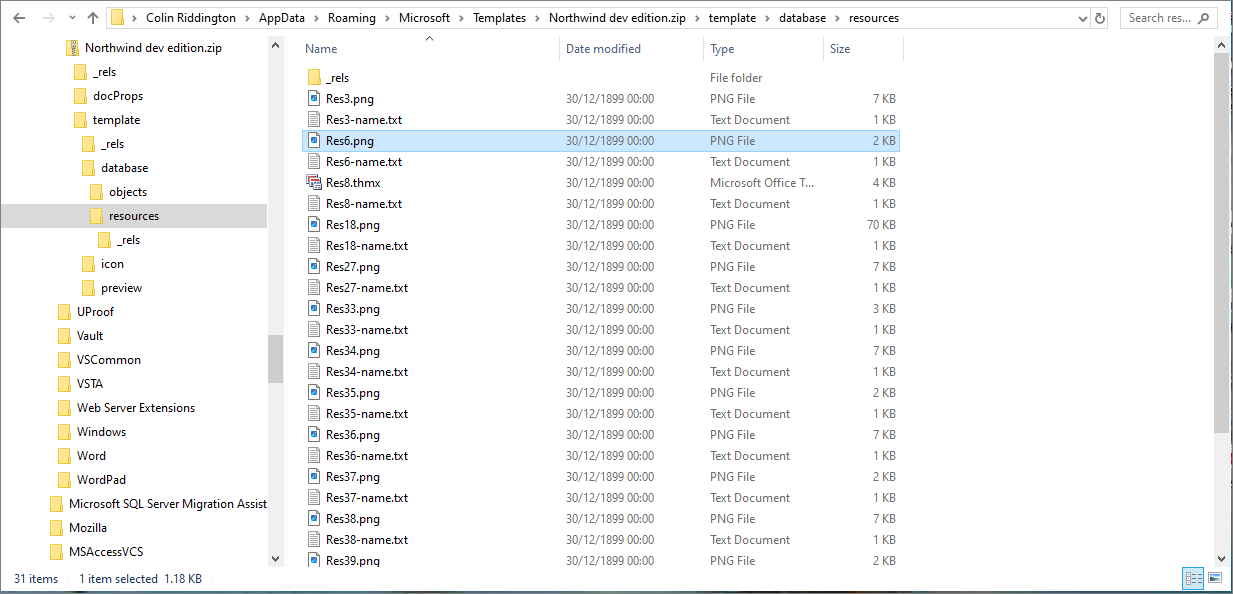
• The resources sub-folder .txt and .png files with the name and image for each shared image object stored in the MSysResources system table together wth the database theme file (.thmx)
• the icon subfolder has a single image file. This is used as the image displayed in the file backstage view

• the preview subfolder also has a single image file. This is used as the image in the startup screen when the Northwind template is opened

As previously stated, you will see the same structure for any .accdt file when examined in this way. SIMPLE!!!
Creating an ACCDB from a Template
When the Create button is clicked on a template file, Access first creates a new empty .accdb file then imports all of the following items into the database:
• Database properties
• VBA References
• Database objects and their properties, events etc
• Table data
• Relationships
• System resources
The reason why the .accdt file structure is identical each time is to ensure that the whole process of 'reassembly' is seamless!
As a result, the creators of the Northwind template databases had to follow very strict guidelines whenever each new version was created.
Thankfully, whenever you create a personal template for your own use, the wizard used in the process does all the hard work for you!
Other Office Files
The structure of many other Office files follows a similar XML based format. Renaming any of the following file types as .zip will expose their file structure:
Word e.g. docx

Excel e.g. xlsx

PowerPoint e.g. pptx

NOTE:
• The XML structure only applies to the newer file formats introduced with Office 2007. It does not apply to the older .doc, .xls, .ppt and .mdb formats from Office 2003 or earlier.
• Newer standard Access file formats (.accdb / .accde) also do not use the XML structure so this approach will not work on those file types.
Feedback
Please use the contact form below to let me know whether you found this article interesting/useful or if you have any questions/comments.
Please also consider making a donation towards the costs of maintaining this website. Thank you
Colin Riddington Mendip Data Systems Last Updated 18 Dec 2025
Return to Access Articles Page
Return to Top