| First Published 24 June 2026 | Last Updated 9 Oct 2026 | Difficulty level : Moderate |
|---|

UPDATES:
2026-07-09: in line with changes made in version 2608
2026-07-19: with additional details about a serious bug (FIXED 2026-07-24)
2026-10-09: updated with changes to width / height limits and rollout to Current Channel version 2609
This article discusses the new 'Big Forms' feature which is rolling out to the Current Channel for Microsoft Access with version 2609 build 20430.20146 released 2026-10-06. This long-requested feature removes the long-standing 22.75 inch (57.79 cm) form size limitation and lays the foundation for a more modern, scalable, and accessible form experience.
The feature also applies to reports.
It was originally rolled out to the Beta Channel at the start of June with version 2606 build 20123.20000 and to Current Channel Preview on 24 June 2026.
The benefits of this new feature are outlined in an official Microsoft blog article: Build bigger forms in Microsoft Access.
The Big Forms Feature
With the release of this feature, the old 22.75 inch (57.79 cm) width limit has been removed. The old section height limit has also been removed.
Form widths are now supported up to 2000 inches (just under 5079.365 cm) which corresponds to 2,880,000 twips.
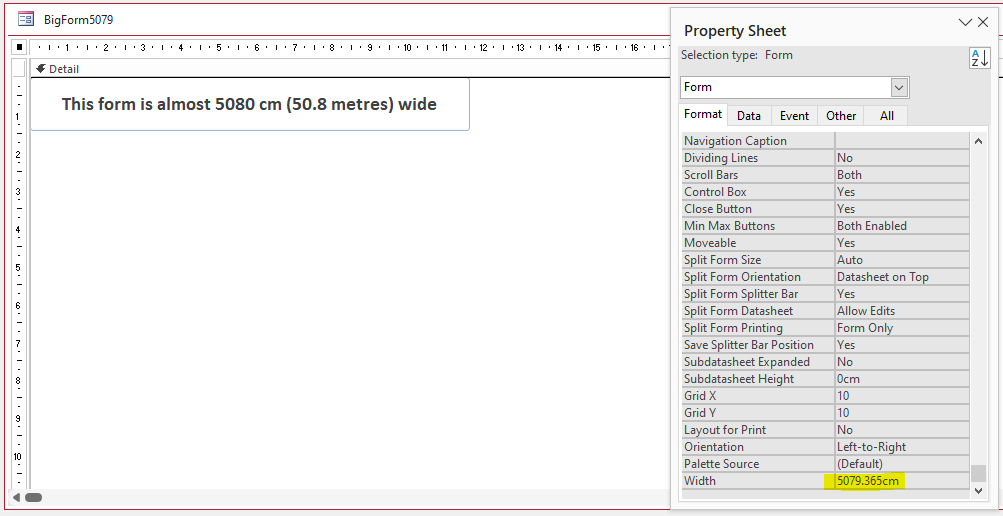
Section heights each have the same limits. The combined height of all sections and their Design View section headers can be up to 2,100 inches (approx 5,334 cm).
For all practical purposes, this means there is no longer a meaningful real-world limit to form (and report) widths or heights.
NOTE:
1. In the original beta release with version 2606, the upper limits were even larger at approximately 93,195 inches / 236,715 cm / 134,200,800 twips.
However, there were some display issues for controls placed to the right edge of forms with widths greater than about 10000 cm.
For now at least, the decision was made to roll out to the production channels with limits set to where these issues weren't a problem.
2. If you try to create a form larger than the new limit, an error message will be displayed:
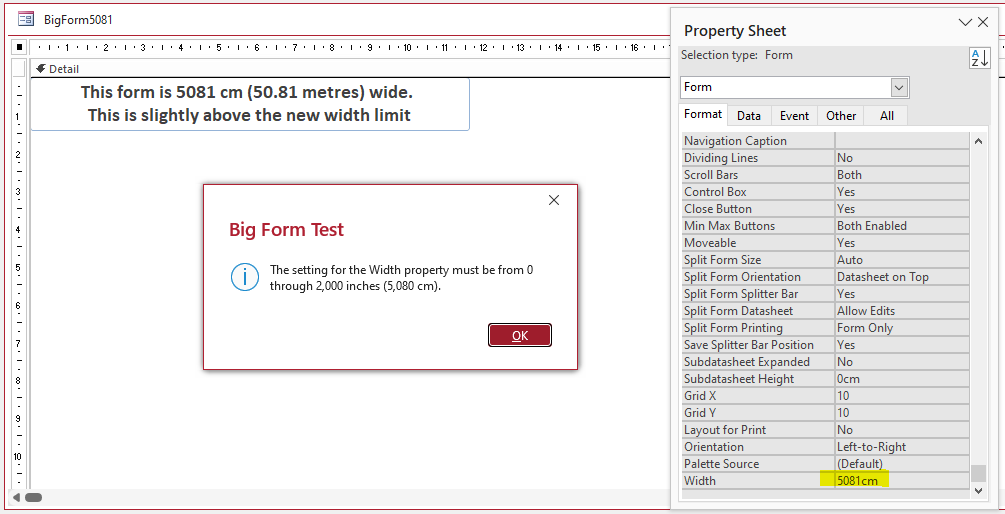
3. 'Big forms' created in new builds will not open in an older version of Access which does not support the feature. A warning message is shown in such cases.

4. The feature can be used either on its own or in conjunction with the new Zooming Feature which was released a couple of months earlier.
Setting the Form and Control Sizes and Positions using code
The old Width, Height, Left and Top properties have been retained for backwards compatibility (and cannot be updated).
The original four properties remain as 16-bit integer datatype and are therefore limited to a maximum value of 32767 in twips (22.75 inches / 57.79 cm) in VBA code.
With the new feature, 4 new long integer properties have been added with the same names as the original Width, Height, Left and Top properties.
Where the property values are below the old integer limit, you can continue to use the concise position/size syntax. For example, to set the positions of two buttons near the right edge of a form 55cm wide:
Private Sub Form_Load()''Values below the old integer twips limit (32767) Me.Command0.Left = 28000 Me.Command1.Left = 28000 Me.Command0.Width = 1500 Me.Command1.Width = 1500End Sub
For all values above the integer limit, you MUST instead use the Properties collection. This looks up and references the new long integer properties.
Where the values are below the integer limit, either version of the code can be used for those properties:
Private SubForm_Load()'Left values above the old integer twips limit (32767)'Must use the Properties collection. This looks up & references the new long integer propertiesMe.Command0.Properties("Left") = 34000Me.Command1.Properties("Left") = 34000'Width values below the integer limit - can use either version of the codeMe.Command0.Width= 1500Me.Command1.Width= 1500End Sub
If you try to use the concise version of the code to set the positions of two buttons near the right edge of a form 65cm wide, you will get an overflow error:

The above code fails because the concise version of the code references the original 16-bit signed integer values.
Additional Info / Known Issues
1. Using the Wizards
The wizards used to create a form or report currently use the old width limits (22.75 inches / 57.79 cm). This causes certain restrictions:
• 'multiple items' continuous forms created using a layout are limited to about 15 fields.
• tabular style continuous forms are limited to about 64 fields and the fields will initially be compressed together.
• datasheet forms can have up to 255 fields but the fields will again initially be 'squashed together'.
However, the form can then be made wider in design view and the widths of each column adjusted either manually or in code.
The attached database includes examples of a datasheet form just over 400 cm wide with 163 fields and a tabular continuous form with 64 fields and almost 200cm wide.
The screenshots below show the tabular continuous form as first created by the wizard and again after the columns have been adjusted using code.

The code used to automatically adjust the column widths and positions at runtime is also included. This is simple for datasheet forms but more complex for continuous forms.
2. Using Big Reports
As with forms, Access also no longer imposes any meaningful limit on report width.
Big reports can now also be created with the same maximum possible sizes but the same layout issues occur if created using the wizard.
You can design reports far larger than the A0 paper size supported by some large format printers / plotters — potentially tens or hundreds of metres wide.
Realistically, when printing reports this feature is only useful up to the maximum paper size supported by your printer. Your printer is now the limiting factor, not Access.
However, very wide reports could also be useful for report view, possibly in conjunction with zooming.
3. Control Size Limits
Individual controls may also have their own size limits, although these are likely to be far larger than needed for all practical purposes.
For example, modern charts appear to be limited to about 800 cm (8 metres) wide. The screenshots below show the same multi-column stacked chart at various widths.
The same data can also be displayed as a pareto chart.
Original restored form (approx 22 cm wide) - the chart data is unreadable

Maximized on 22 inch monitor (approx 50 cm wide) - better but still squashed

On a big form approx 200 cm wide - column data now much easier to read

On a big form approx 800 cm wide

The chart does not expand any further when arranged to stretch across a form much wider than 800cm.
However, no matter what width form is used, it can still be zoomed in or out as required.
4. Other form/report properties such as WindowWidth/WindowHeight/WindowLeft/WindowTop have not been updated and remain as 16-bit integer datatype.
Their values are still limited to 32767 twips (22.75 inch/57.79 cm).
Download
Click to download the example databases used in this article (all have been updated for version 2609 or later):
Big Form Tests v1,4 Approx 3 MB (zipped)
Big Form Charts v1.3 Approx 0.9 MB (zipped)
NOTE:
a) The example databases will currently only run in Current Channel / Current Channel Preview / Beta Channel version 2609 (or later).
b) The code in these databases is not optimized and there may be some unintended display glitches.
As is the case for all files downloaded from the internet, first unblock the downloaded files, then unzip, and save to a trusted location.
For more details, see my article:
Unblock downloaded files by removing the Mark of the Web
Feedback
Please use the email button in the contact form below to let me know whether you found this article useful or if you have any questions.
Please also consider making a donation towards the costs of maintaining this website. Thank you
| Colin Riddington | Mendip Data Systems | Last Updated 9 Oct 2026 |
|---|
|
Return to Access Articles Page
|
Return to Top
|